Sanctions Placed on Gurpreet Singh
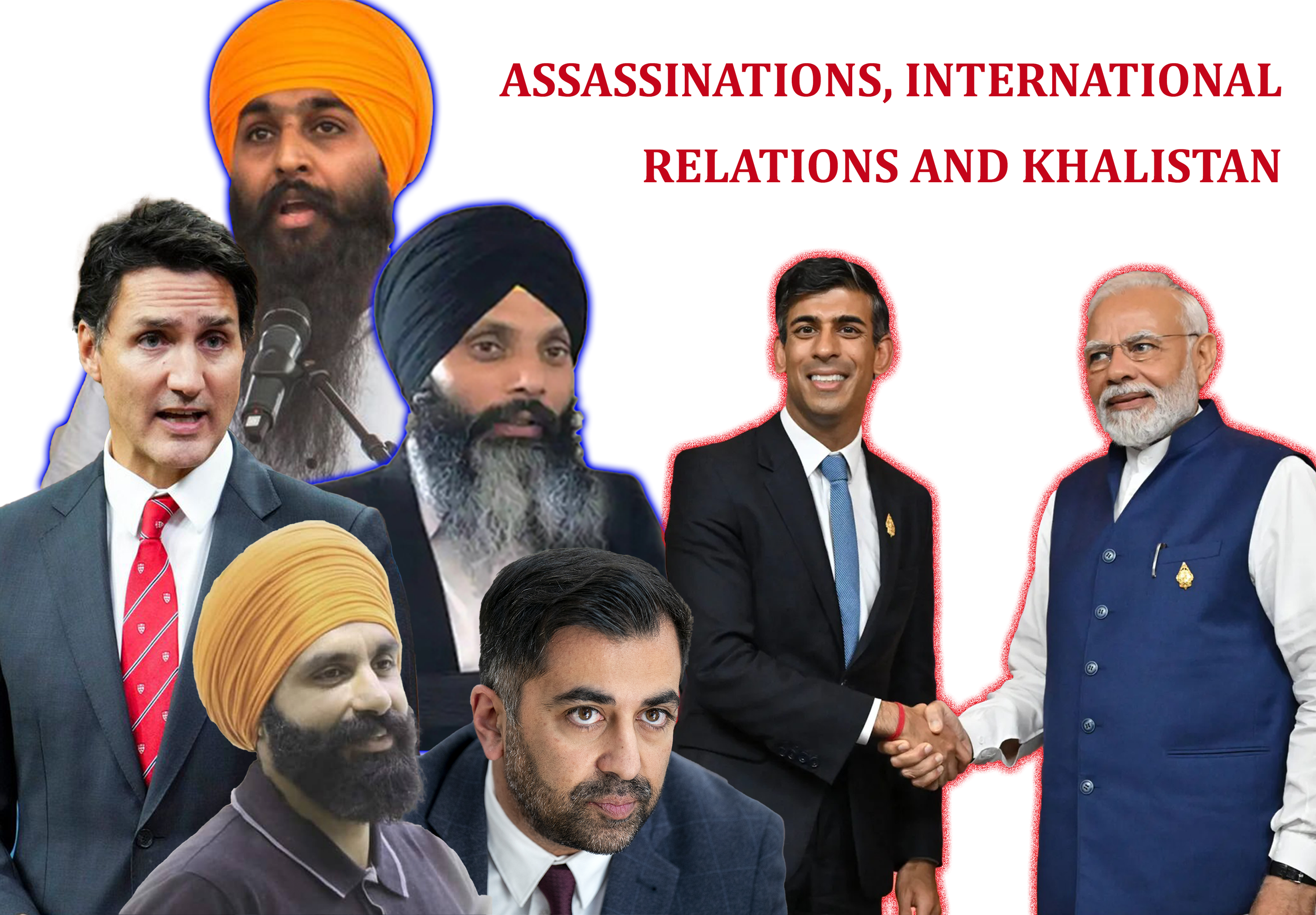
/The UK announced on the 4th of December 2025 an asset freeze and director disqualification against Gurpreet Singh Rehal, who is suspected of belonging to organisations involved in “terrorism” in India, in its first use of the Domestic Counter-Terrorism Regime to disrupt funding for Babbar Khalsa.
The event received extensive media coverage, with images of Gurpreet Singh featured on front pages worldwide. Over 200 Sikh organizations spanning 12 countries across three continents have collectively expressed their condemnation of the United Kingdom's decision:
“The sanctions look to be based on unverified and unscrutinised intelligence, likely supplied by foreign authorities, such as India, with a vested interest in silencing him and his work.”
Who is Gurpreet Singh
Leading Sikh groups have criticised this latest stunt to undermine Sikh activism in the UK at the behest of the Indian Government. Although numerous front-page news articles have covered the story, none offer additional context concerning Gurpreet Singh. The brief statement by the UK government contained politically charged claims of “terrorist financing”, which fuelled salacious articles that conjure up images of a shadowy and mysterious figure.
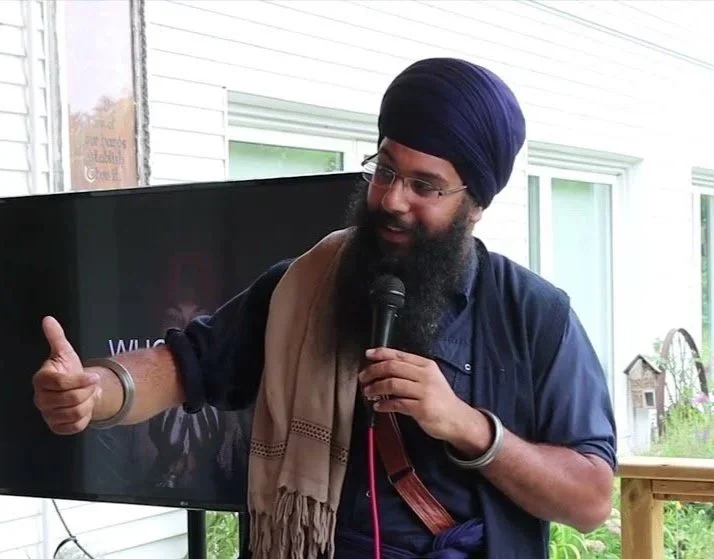
The truth is, Gurpreet Singh is a well-known and well-liked Sikh activist who has been working for several years in the Panthic space. His pioneering work with Saving Punjab, an award-winning advocacy organization dedicated to addressing various challenges faced by Punjab, has taken him to the 2023 United Nations Water Conference in New York, where he addressed global diplomats on the diversion of Punjab's river waters and its long-term impact.
Using politically charged terms like terrorism, without evidence of risk or criminal activity, serves only to vilify Khalistan activists. A million miles from the image attempted to be conjured up, Gurpreet Singh is a beloved family man, a devoted husband, and a doting father to his young adorable children.
Being a Northerner, and several years younger than me, I had never actually met him until a few years ago. I was really impressed with the work he and his organization were doing and obtained his contact details from a mutual friend.
He was introduced to me as ‘Biggie’, as a diehard Tupac fan throughout my youth alarm bells were ringing. When we first spoke on the phone, after exchanging Fateh, I quickly enquired, “so…why do they call you Biggie”, “well, I’m 6 foot 4 and over 120 kilos” he replied in a soft Yorkshire accent. He became a friend from there on.
Far from an underground criminal terrorist, he was recently in the news as the public face of a Sikh consortium, the Punjab Warriors, who recently acquired the Morecambe Football Club. Just two days before potential expulsion from the National League, the 105-year-old football team was saved from oblivion on the 18th of August 2025. Gurpreet Singh was there on the first day of ownership speaking to the press as the head of communications for the group.
The images of a grinning Gurpreet Singh in a large Dumaala were beamed across the world as Sikhs celebrated this historic moment. However, it appears this media coverage, including an interview broadcasted on the BBC with Gurpreet Singh, ruffled a few Indian feathers.
In addition to his international advocacy, Gurpreet Singh is also a prominent speaker and advocate for Khalistan. Believing as most Sikhs do, that the ecological, social, political and economic injustices suffered by Punjab, are the symptoms of repression under Indian rule, and a consequence of the loss of Sikh sovereignty. It is this aspect of his advocacy that India is triggered by. Advocacy work on ecological issues in Punjab occurs most prominently in Punjab itself, it is only when the real solution of Khalistan is espoused, that the Indian state mobilises.
Bringing the cause of Khalistan further into the mainstream is the Indian state’s greatest fear. This is where Gurpreet Singh’s greatest threat rests. His work was tying together advocacy of Khalistan with international diplomatic efforts and global education initiatives. You can imagine Indian anxiety levels when Gurpreet Singh’s pearly whites were being flashed holding the Morecambe FC’s football scarf on the BBC:
"Punjab, the land of five rivers, is our native land. For us, our heritage, our culture and our faith are our core principles. They make us who we are.”
-Punjab Warriors quoted in the BBC
Less than a month later Gurpreet Singh along with other connected activists were arrested on suspicion of being concerned in the commission, preparation or instigation of acts of terrorism under section 41 of the Terrorism Act 2000.The authorities undertook a detailed forensic examination of his home and personal devices, and after 12 days in police custody he was released with no charge.
UK Shoulders Indian Rifle
While blaming the Indian government for everything can become cringeworthy, there is genuine and substantive evidence that the UK authorities are increasingly succumbing to pressure from its former colony.
Over the past 50 years India has transformed into one of the fastest-growing economies and is projected to become the third-largest global economy by 2028, surpassing the UK in 2022. India's growth is accompanied by a period of rapid inflation in the UK, creating a cost of living crisis and the risk of a recession, coupled with a turbulent political period and the continued aftershocks of Brexit. This changing of fortunes has resulted in a shift in the balances of power.
From the 1980s the UK's economy (£250 billion) was substantially larger than India's (£77 billion), in 2024 the UK's GDP was approximately £2,884 billion. India's GDP in the same year was approximately £3,269 billion.
India has openly expressed its intent to limit Khalistani activism among Sikh diaspora communities, and is prepared to use trade agreements to address the issue, particularly given the UK's weakened trade position after Brexit.
Earlier this year, Prime Minister Narendra Modi while meeting his counterpart Keir Starmer in July and October repeatedly raised the issue of Khalistani activity, arguing that the movement should be afforded “no space in democratic societies and should not be allowed to use or abuse the freedoms provided by societies, and there was a need to move against them in the legal framework available on both sides.”
These meetings were not ordinary but preceded a landmark occasion, the July meeting saw the passing of the India–UK Comprehensive Economic and Trade Agreement (CETA), marking India’s first full-scale free trade agreement with a G7 economy. An agreement years in the making, which aims to double bilateral trade to approximately £94.5 billion by 2030, through the near-complete elimination of tariffs on goods.
Khalistan was not an afterthought; before the historic meeting in July, India had laid the foundations by announcing its intention to "make a strong pitch against Khalistani activists" as a vital precondition for the agreement.
The repeated requests regarding Khalistan during the signing of a trade agreement worth hundreds of billions of pounds, highlight the seriousness in which the Modi regime assesses the threat of the Khalistan movement, and in particular the importance of the role the Sikh diaspora can (indeed must) play.
What was less publicised in these meetings, was a footnote reference to India–UK Vision 2035, a joint roadmap launched alongside the agreement to deepen cooperation between the two nations. In regard to matters of security the document details the requirement to:
Condemn terrorism in all its forms and manifestations. Strengthen international cooperation to combat terrorism in a comprehensive and sustained manner, in accordance with the UN Charter and international law. Counter radicalisation and violent extremism; combat financing of terrorism and the cross-border movement of terrorists; prevent exploitation of new and emerging technologies for terrorist purposes; tackle terrorist recruitment; strengthen bilateral and multilateral cooperation in these spheres, including in information sharing, judicial cooperation, capacity building. Strengthen cooperation to take decisive and concerted actions against globally proscribed terrorists, terror entities and their sponsors.
Keir Starmer then met Prime Minister Modi in Mumbai on 9 October 2025, which was billed as the “victory lap” for the agreement signed in July, and was again pressured by Modi about Khalistani advocacy. The arrest of Gurpreet Singh and three others in September 2025, had led to no evidence of any crime, but continued the increased harassment of Sikh activists in recent years.
Shortly after Starmer’s visit to India in October, the UK government issued grave economic sanctions against Gurpreet Singh, in the absence of any criminal charges. The Indians watching intently were quick to claim the victory:
“We welcome the steps taken by the UK government to sanction anti-India extremist entities, which strengthen the global fight against terrorism and extremism and help to curb illicit financial flows and transnational crime networks,”
-Randhir Jaiswal, External affairs ministry spokesperson (8th December 2025)
Money over Death
“The India–UK FTA was not signed in a vacuum. It reflects India’s evolving trade philosophy…If the UK continues treating Khalistani extremism as protected speech and drags its feet on extraditions, India may weaponize trade leverage. This is not economic nationalism—it’s strategic reciprocity.”
-Dinesh Singh Rawat, Practising Advocate and Senior Geopolitical Analyst.
There is a long-standing pattern between Indian pressure and groundless UK crackdowns on Sikh activists, which eventually resulted in the trade deals that India was teasing the UK with. Spurred into action, eager to please, the UK authorities response is hysterical and theatrical; full-scale investigations, raids and litigation launched with zero public interest, and even less chances of success. These actions are designed solely for emphasis, to rile up the Indians to a frenzy, and if possible, discredit and disband Sikh activist networks in the process.
Brief Timeline Showing Cause and Effect of Indian Pressure
2016
14 November 2016 – Indian officials lodged protests after pro Khalistan rallies in London.
Early signals that Khalistan advocacy was seen as a barrier to closer trade ties.
4 November 2017- Through intelligence provided by MI5 and MI6 identifying Jagtar Singh Johal as a Sikh activist to the Indian authorities, he is detained and tortured in India.
8 years later the Indian Government has failed to substantiate their claims, and Johal remains in prison
2018
18 April 2018 –Modi’s visit to London (Commonwealth Heads of Government Meeting). Raises concerns about Khalistani protests outside the Indian High Commission.
Trade talks were exploratory; India warned that tolerance of extremism undermined trust in partnership.
On September 18, 2018, the homes of five Sikh activists raided by Counter Terrorism Unit officers acting on information from India.
No evidence is found to lead to any charges, all 5 are released without charge
2020
15–17 December 2020 – UK Foreign Secretary Dominic Raab visits India as Britain struggles post-Brexit and the Covid pandemic. The roadmap outlined by the Indians makes clear that Khalistan is a major hurdle and obstacle to trade.
Mere days after Raab returned, three Sikh activists were arrested in the UK in relation to the assassination of the leader of a Hindu supremacist paramilitary organisation (RSS), over 11 years prior. India attempts to extradite the three with the UKs support.
Extradition trial fails. District Judge Michael Snow questions why Home Secretary Priti Patel had certified the extradition request and ordered a judge to issue arrest warrants, which legal experts argue were "made on the basis of wholly unsubstantiated allegations".
Beacon for Human Rights?
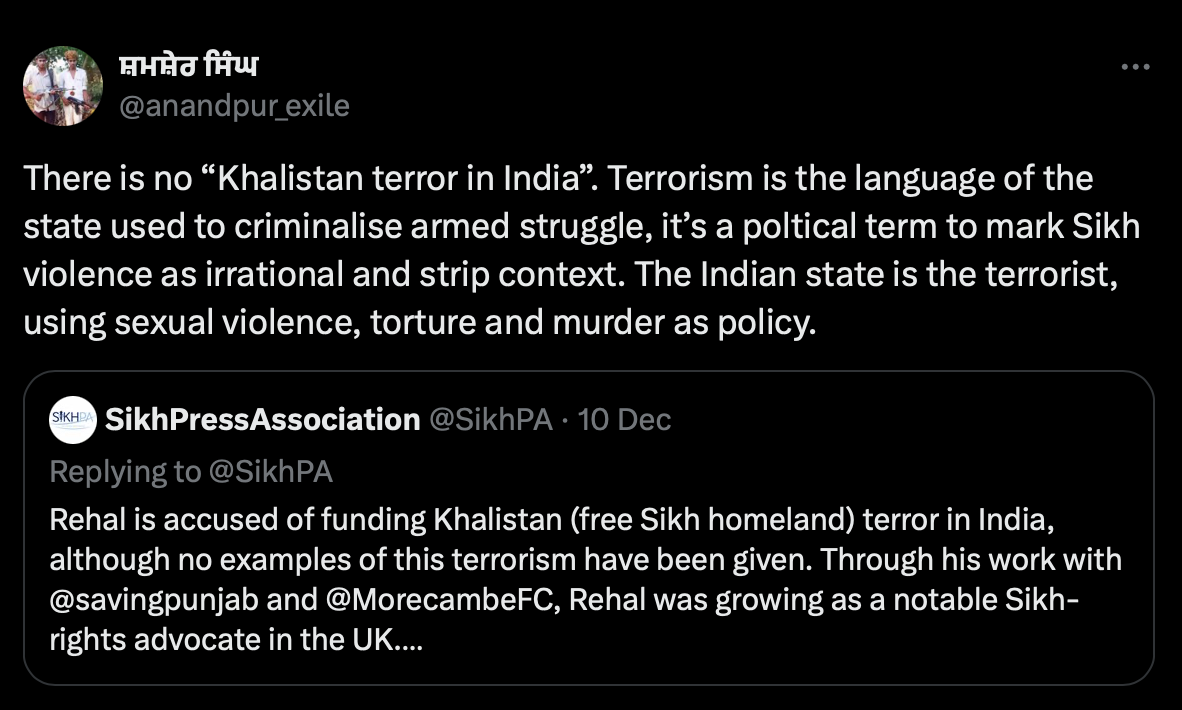
There is a section of Sikhs who readily accept the legitimacy and credibility of the UK government. Sikhs whose sense of sovereignty is so far eroded by colonialism that they didn’t question the imperial invasions of Iraq or Afghanistan and justified the death of millions.
India is relying upon the veneer of credibility the UK somehow maintains, to criminalise and defame the liberation struggle of Khalistan. We must push back against this narrative and this attack on our activists, our institutions, and our liberation struggle.
If the UK is a beacon of human rights, it is a beacon that is sited on top of a mountain of skeletons, of millions of enslaved and trafficked Africans. If the UK is a beacon for human rights, it is a beacon that diverts focus from itself and its allies, so they can continue to operate in the dark shadows of its hypocritical light.
Britain built its empire on enslavement for three centuries before celebrating itself as the global moral leader by outlawing the trade of enslaved people in 1807 and enslavement in 1833. Abolishment only came when uprisings and the depletion of soil on plantations made it no longer profitable, compared to the Industrial Revolution enslaved labour funded. Britain then enforced abolition through its navy to undermine its rivals whose economies still relied upon enslavement.
Let us not forget Nelson Mandela, who co-founded the armed wing of the ANC, and advocated for armed struggle against the apartheid regime after non-violent methods failed. He was condemned by the West for decades as a terrorist, while the apartheid regime was supported. When he became President and travelled to the United States in October 1994, Mandela was still on the US terrorism watch list, which he would remain on until 2008, nearly two decades after his release from prison. (It comes as no surprise that it was the CIA who tipped off the South Africans authorities of his whereabouts leading to his arrest.)
Imperial invasions and “interventions” of Iraq, Afghanistan, Syria, Libya were never intended to deliver democracy, but greater dividends to the shareholders of corporations who profited from the death and destruction of the global South.
Those with historical amnesia, should consider how the UK and its Western allies continue to support the ongoing genocide in Palestine, which has live streamed the massacre of over 70,000 Palestinians, the overwhelming majority of whom are civilians.
It is imperative for Sikhs to note that the West has condemned and criminalised Palestinian resistance, while defending and arming Israel.
While Gurpreet Singh and other activists face economic sanctions, travel restrictions and threats to their liberty, there has been no action taken by the UK against the Israeli state nor the transnational repression against Sikhs by India.
Future of the Khalistan Movement in the UK
India’s attempt to curb Khalistan activism in the UK is ironic given the fact they have not been able to silence the movement for Khalistan within Indian occupied Punjab. Despite the risk of state repression, Sikhs in Punjab defiantly celebrate the martyrs of the Khalistan movement, including the annual commemoration of the martyrdom of Jathedar Bhai Sukhdev Singh Babbar, one of the founders of the Babbar Khalsa.
The UK has long been a haven for political dissidents. Historically groups representing one of the many liberation movements against India, have been afforded greater rights of speech and organisation in the UK than in India. The Khalistan Government in Exile was established in the UK, and was directly linked to the armed Khalistan fighting forces in Punjab.
British intelligence has been monitoring Sikh activism since the 1980s and has been aware of the organising and logistical support that Sikhs in the diaspora have provided. For decades Indian intelligence has published the details of Sikh elders who were openly raising funds for groups such as the Babbar Khalsa. Whilst very few Sikhs in the diaspora ventured into the battlefield, many contributed towards the liberation struggle, a time-honoured tradition tracing back to when Sri Guru Hargobind Sahib gave his first command, ordering Sikhs to provide offerings of weapons and horses, to militarise and defend the Sikh nation.
The UK government’s continued assault on Sikh activists in the UK, seeking to further curtail our legitimate right to pursue self-determination, only strengthens the cause for Khalistan. Sikhs must push back and challenge the conditions they are facing. Sikhs, as a sovereign people, and in respect of their history, inherently reject the authority of the UK government in defining who our heroes are, what our activism looks like, and UK efforts in demonising our movement as “terrorist”. The UK government was a key ally to the US, and supported the CIA’s Operation Cyclone, which financed the Afghan militants to the tune of roughly $9–11 billion in today’s money. This led to preeminence of the Taliban who were then attacked in 2001, in a war which lasted 20 years and cost trillions, only for the west to be forced to accept the Taliban’s return to power as the government of Afghanistan.
From Mandela to McGuinness, history has recognised armed struggle as being a necessary means, from the battlefield to the ballot box, and often in the battlefield and at the ballot box, to liberation.
The Khalsa remains committed to the establishment of an egalitarian society, Khalistan. The foundation of our nation is rooted in righteousness. The UK government’s continued actions show that they are still trading bodies for gold. The Sikhs will continue to serve the Guru Panth, through their Dhan Man Thanh (body, mind, and wealth), and it is for Sikhs, and Sikhs alone, in the words of Shaheed Bhai Jaswant Singh Khalra, to decide “who is the terrorists and who is the righteous”.
Khalistan Zindabad